
Fluent Assertions Documentation
FluentAssertions Assembly / FluentAssertions.Numeric Namespace / ComparableTypeAssertions<T> Class
In This Topic
    ComparableTypeAssertions<T> Class
    In This Topic
    Contains a number of methods to assert that an IComparable is in the expected state.
    Object Model
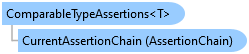
    ComparableTypeAssertions<T> ClassAssertionChain Class
    Syntax
    Type Parameters
    T
    Inheritance Hierarchy
    Public Constructors
    Public Properties
     NameDescription
    Public PropertyProvides access to the FluentAssertions.Execution.AssertionChain that this assertion class was initialized with. (Inherited from FluentAssertions.Primitives.ReferenceTypeAssertions<IComparable<T>,TAssertions>)
    Public Property Gets the object whose value is being asserted. (Inherited from FluentAssertions.Primitives.ReferenceTypeAssertions<IComparable<T>,TAssertions>)
    Top
    Protected Properties
     NameDescription
    Protected Property Returns the type of the subject the assertion applies on. It should be a user-friendly name as it is included in the failure message. Returns the type of the subject the assertion applies on. (Inherited from FluentAssertions.Numeric.ComparableTypeAssertions<T,ComparableTypeAssertions<T>>)
    Top
    Public Methods
     NameDescription
    Public MethodAsserts that an object equals another object using its System.Object.Equals(System.Object) implementation.
    Verification whether CompareTo returns 0 is not done here, you should use ComparableTypeAssertions<T,TAssertions>.BeRankedEquallyTo to verify this. (Inherited from FluentAssertions.Numeric.ComparableTypeAssertions<T,ComparableTypeAssertions<T>>)
    Public MethodOverloaded. Asserts that the object is assignable to a variable of type T. (Inherited from FluentAssertions.Primitives.ReferenceTypeAssertions<IComparable<T>,TAssertions>)
    Public MethodOverloaded.  Asserts that an object is equivalent to another object. (Inherited from FluentAssertions.Numeric.ComparableTypeAssertions<T,ComparableTypeAssertions<T>>)
    Public MethodAsserts that the subject is greater than another object according to its implementation of IComparable. (Inherited from FluentAssertions.Numeric.ComparableTypeAssertions<T,ComparableTypeAssertions<T>>)
    Public MethodAsserts that the subject is greater than or equal to another object according to its implementation of IComparable. (Inherited from FluentAssertions.Numeric.ComparableTypeAssertions<T,ComparableTypeAssertions<T>>)
    Public Method Asserts that a value is within a range. (Inherited from FluentAssertions.Numeric.ComparableTypeAssertions<T,ComparableTypeAssertions<T>>)
    Public MethodAsserts that the subject is less than another object according to its implementation of IComparable. (Inherited from FluentAssertions.Numeric.ComparableTypeAssertions<T,ComparableTypeAssertions<T>>)
    Public MethodAsserts that the subject is less than or equal to another object according to its implementation of IComparable. (Inherited from FluentAssertions.Numeric.ComparableTypeAssertions<T,ComparableTypeAssertions<T>>)
    Public Method Asserts that the current object has not been initialized yet. (Inherited from FluentAssertions.Primitives.ReferenceTypeAssertions<IComparable<T>,TAssertions>)
    Public MethodOverloaded. Asserts that the object is of the specified type T. (Inherited from FluentAssertions.Primitives.ReferenceTypeAssertions<IComparable<T>,TAssertions>)
    Public MethodOverloaded. Asserts that a value is one of the specified validValues. (Inherited from FluentAssertions.Numeric.ComparableTypeAssertions<T,ComparableTypeAssertions<T>>)
    Public MethodAsserts that the subject is ranked equal to another object. I.e. the result of CompareTo returns 0. To verify whether the objects are equal you must use ComparableTypeAssertions<T,TAssertions>.Be. (Inherited from FluentAssertions.Numeric.ComparableTypeAssertions<T,ComparableTypeAssertions<T>>)
    Public Method Asserts that an object reference refers to the exact same object as another object reference. (Inherited from FluentAssertions.Primitives.ReferenceTypeAssertions<IComparable<T>,TAssertions>)
    Public Method (Inherited from FluentAssertions.Primitives.ReferenceTypeAssertions<IComparable<T>,TAssertions>)
    Public MethodOverloaded. Asserts that the predicate is satisfied. (Inherited from FluentAssertions.Primitives.ReferenceTypeAssertions<IComparable<T>,TAssertions>)
    Public MethodAsserts that an object does not equal another object using its System.Object.Equals(System.Object) method.
    Verification whether CompareTo returns non-zero is not done here, you should use ComparableTypeAssertions<T,TAssertions>.NotBeRankedEquallyTo to verify this. (Inherited from FluentAssertions.Numeric.ComparableTypeAssertions<T,ComparableTypeAssertions<T>>)
    Public MethodOverloaded. Asserts that the object is not assignable to a variable of type T. (Inherited from FluentAssertions.Primitives.ReferenceTypeAssertions<IComparable<T>,TAssertions>)
    Public Method Asserts that a value is not within a range. (Inherited from FluentAssertions.Numeric.ComparableTypeAssertions<T,ComparableTypeAssertions<T>>)
    Public Method Asserts that the current object has been initialized. (Inherited from FluentAssertions.Primitives.ReferenceTypeAssertions<IComparable<T>,TAssertions>)
    Public MethodOverloaded. Asserts that the object is not of the specified type T. (Inherited from FluentAssertions.Primitives.ReferenceTypeAssertions<IComparable<T>,TAssertions>)
    Public MethodAsserts that the subject is not ranked equal to another object. I.e. the result of CompareToreturns non-zero. To verify whether the objects are not equal according to System.Object.Equals(System.Object) you must use ComparableTypeAssertions<T,TAssertions>.NotBe. (Inherited from FluentAssertions.Numeric.ComparableTypeAssertions<T,ComparableTypeAssertions<T>>)
    Public Method Asserts that an object reference refers to a different object than another object reference refers to. (Inherited from FluentAssertions.Primitives.ReferenceTypeAssertions<IComparable<T>,TAssertions>)
    Public MethodAllows combining one or more assertions using the other assertion methods that this library offers on an instance of T. (Inherited from FluentAssertions.Primitives.ReferenceTypeAssertions<IComparable<T>,TAssertions>)
    Top
    Extension Methods
     NameDescription
    Public Extension MethodSafely casts the specified object to the type specified through TTo.
    Public Extension MethodOverloaded. Invokes the specified action on a subject so that you can chain it with any of the assertions from FluentAssertions.Specialized.NonGenericAsyncFunctionAssertions
    Public Extension MethodOverloaded. Forces enumerating a collection. Should be used to assert that a method that uses the yield keyword throws a particular exception.
    Public Extension Method Provides methods for asserting the execution time of a method or property.
    Public Extension MethodOverloaded. Invokes the specified action on a subject so that you can chain it with any of the assertions from FluentAssertions.Specialized.ActionAssertions
    Public Extension MethodOverloaded. Starts monitoring eventSource for its events.
    Public Extension MethodOverloaded. Returns an FluentAssertions.Specialized.ExecutionTimeAssertions object that can be used to assert the current FluentAssertions.Specialized.ExecutionTime.
    Public Extension MethodOverloaded. Returns an FluentAssertions.Primitives.EnumAssertions<TEnum,TAssertions> object that can be used to assert the current TEnum.
    Top
    Supported Frameworks

    .NET: net5.0, net5.0-windows, net6.0, net6.0-macos, net6.0-windows, net7.0, net7.0-macos, net7.0-windows, net8.0, net8.0-browser, net8.0-macos, net8.0-windows, net9.0, net9.0-browser, net9.0-macos, net9.0-windows, net10.0, net10.0-browser, net10.0-macos, net10.0-windows.

    .NET Standard: netstandard2.0, netstandard2.1.

    .NET Framework: net40, net403, net45, net451, net452, net46, net461, net462, net463, net47, net471, net472, net48, net481.

    See Also